Running shoe review
ASICS Novablast 6 Review
Can One Shoe Handle Most of Your Training?

Best for
Runners wanting one shoe mainly for easy mileage and long runs.
The ASICS Novablast 6 suits everyday mileage and long runs with occasional faster stretches, offering improved road grip and a responsive forefoot. Its padded fit and mixed heel-transition feedback make fit and...
Verdosa score
Best for
Runners wanting one shoe mainly for easy mileage and long runs.
What we loved
- FF Turbo² forefoot foam adds a responsive toe-off without a plate.
- Improved forefoot rubber earns strong wet-road feedback and encouraging laboratory traction results.
- Padded touchpoints and secure lockdown make comfort a recurring strength in independent reviews.
What could be better
- Heel transitions divide reviewers; some find the rearfoot flat or clunky.
- A tapered toe box and thick heel padding may limit comfortable space.
- Breathability reports conflict, with several testers finding the upper warm.
Verdosa verdict
The ASICS Novablast 6 suits everyday mileage and long runs with occasional faster stretches, offering improved road grip and a responsive forefoot. Its padded fit and mixed heel-transition feedback make fit and stride compatibility important qualifications.
✓Who should buy it?
- Runners wanting one shoe mainly for easy mileage and long runs.
- Midfoot or forefoot runners who value a springier toe-off.
- Buyers prioritising improved road traction and padded comfort.
−Who should skip it?
- Runners primarily shopping for dedicated speed sessions or racing.
- Wide-footed runners who find the tapered front restrictive.
- Heel strikers who dislike its rearfoot transition when trying it.
Verdosa review
Best for
Daily mileage and long runs with occasional faster stretches.
Affiliate disclosure: Verdosa may earn a commission from purchases through this link, at no extra cost to you.
The ASICS Novablast 6 can cover most everyday training if you want cushioned easy miles, long runs and occasional pace increases from one shoe. Its new forefoot foam pod adds a springier toe-off, while independent testing supports the improved road grip. The qualification is the heel: some reviewers find it comfortable and controlled; others describe a flat, clunky transition. It is less convincing as your only shoe for dedicated speed sessions.
Specifications
| Specification | Details |
|---|---|
| Category | Neutral road daily trainer. |
| Intended use / distance | Easy, recovery and long runs; occasional faster efforts. Marathon use supported by some reviewers. |
| Weight | RUN-ARE measured 242 g, men's US 8.5. RunRepeat: 249 g lab; sample size not supplied. Reported men's figures vary. |
| Stack height | Reported men's: 41.5 mm heel / 33.5 mm forefoot; women's: 40.5 / 32.5 mm. RunRepeat lab: 39.2 / 32.1 mm. |
| Drop | Reported: 8 mm; RunRepeat lab: 7.1 mm. |
| Midsole | FF Blast Max carrier with an FF Turbo² forefoot pod. |
| Plate / rods / stiffening structure | No plate, as reported by RUN-ARE and Runners' Lab; rods: Not provided. |
| Upper | Engineered woven upper; gusseted tongue and padded heel collar. |
| Outsole | ASICSGRIP forefoot rubber; AHAR rearfoot rubber. Some accounts specify AHAR LO. |
| Fit | Reviewers report true-to-size to slightly short; tapered toe box and secure midfoot. Subjective findings vary. |
| Release date | Not provided |
Where does the Novablast 6 work best?
Everyday mileage is its clearest role. The FF Blast Max carrier supplies the bulk of the cushioning, while FF Turbo² sits specifically beneath the forefoot. This is not a full-length super-foam midsole: the springiest sensation is concentrated towards toe-off.
That distinction helps explain the mixed ride reports. Ben Parkes describes smooth transitions and broad versatility. Doctors of Running and RUN-ARE find the heel less lively, with a more abrupt transition into the responsive front section.
The Running Channel found its strongest pace range extended from recovery running to marathon pace. RUN-ARE was less enthusiastic about workout use. Treat faster stretches as a useful extra rather than the main reason to buy it. If you predominantly land on your heels, assess the rearfoot transition carefully before committing to long training runs.
Inside the shoe: cutaway video
The ASICS Novablast 6 is cut open to show its internal construction.
Video credit: Foot Doctor Zach.
Will the fit and padding suit you?
Expect secure hold, but check toe clearance rather than assuming your usual size will work. RUN-ARE found a true-to-size fit with comfortable front space; Doctors of Running found the shoe slightly short because the thick heel padding pushes the foot forward. RunRepeat also measured a tapered toe box.
A narrow-to-normal foot is the more straightforward match. Wider feet, or feet that swell during long runs, need particular care around the big toe.
The padded collar and tongue offer comfort, but their warmth is a trade-off. RunRepeat's laboratory assessment and some reviewers praise ventilation; RUN-ARE and Runner's World report a warmer experience. Hot-weather runners should treat breathability as unresolved rather than a guaranteed strength.
Are grip and durability convincing?
Grip is one of the better-supported improvements. RUN-ARE reports confident traction on wet asphalt, Runner's World testers praise wet-road hold, and RunRepeat records strong forefoot traction in its laboratory test. Those findings support road use; they do not establish suitability for technical trails.
Early wear results are encouraging. Doctors of Running reported no rubber wear after 45 miles, while RunRepeat's abrasion tests found good upper and outsole resistance.
Ben Parkes raises a longer-term concern based on his Novablast 5 experience. That is a reason to watch foam longevity, not evidence that the Novablast 6 will lose responsiveness at a specific mileage.
Is it worth the price?
Typical price: £140 UK | €160 EU | US$155 US. Prices vary by retailer, size and colourway.
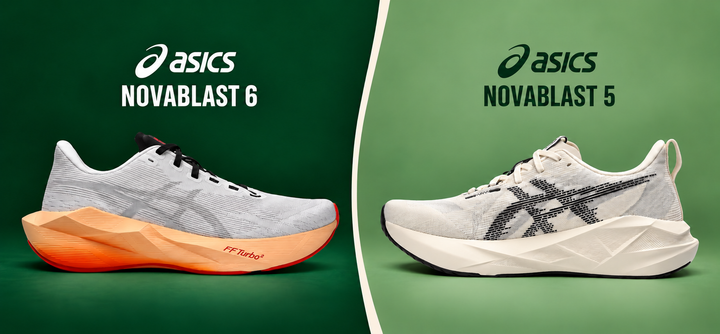
Its value rests on covering frequent training miles comfortably. Ben Parkes favours the lighter, livelier adidas Adizero Evo SL for speedwork, while finding the Novablast more comfortable and reassuring for longer training. The ASICS Superblast 3 offers a more responsive premium alternative in several supplied reviews, at a higher reported price.
For Novablast 5 owners, improved grip and the forefoot pod provide concrete reasons to consider upgrading.


Swipe or scroll to view all six product images.
Check price on AmazonAffiliate disclosure: Verdosa may earn a commission from purchases through this link, at no extra cost to you.
Final Verdict
The ASICS Novablast 6 makes a credible one-shoe choice when most of your training consists of easy mileage and long runs, with occasional faster stretches. Improved road grip and a responsive forefoot strengthen its appeal, but the ride is not equally lively from heel to toe. Choose it if the padded fit feels comfortable and the rearfoot transition suits your stride. Look elsewhere if dedicated speedwork, generous toe room or a consistently springy heel matters more than everyday versatility.
FAQ
Does the Novablast 6 have a carbon plate?
No. The supplied reviews describe an unplated shoe, with a forefoot foam pod supplying extra responsiveness.
Can you run a marathon in it?
Some supplied reviewers support marathon use. Comfort over long runs and suitability at your planned pace matter more than distance alone.
Is it a stability shoe?
No. It is classified as neutral. Stability impressions vary, so its geometry should not be treated as a substitute for your support needs.
Should you size up?
There is no universal rule. Reports range from true-to-size to slightly short; check toe clearance and compare adjacent sizes if needed.